Student & Graduate CV Examples — With Honest Feedback
Our team has spent years on the other side of the hiring table — screening CVs, shortlisting candidates, and hiring for entry-level and graduate positions. We've reviewed hundreds of student applications, and after a while, the patterns become impossible to miss. The same strengths, the same gaps, the same fixable mistakes showing up again and again.
So we wrote three realistic student CVs and marked them up the same way we would during a hiring round. No vague advice, no "it depends." Just honest reactions to what works, what doesn't, and what we'd want to see changed before passing a candidate through.
The CVs below represent students and recent graduates at different stages. One has a solid internship under her belt. One graduated with honours but no formal work experience. One is pivoting into an entirely different field from the degree she studied. All three are applying for entry-level roles in the UK.
Each example is followed by direct, specific, and occasionally blunt feedback. Generic advice is everywhere. What's harder to find is someone telling you exactly what goes through a hiring manager's mind when they see your CV for the first time.
Example 1: Sarah Mitchell — Final-Year Marketing Student
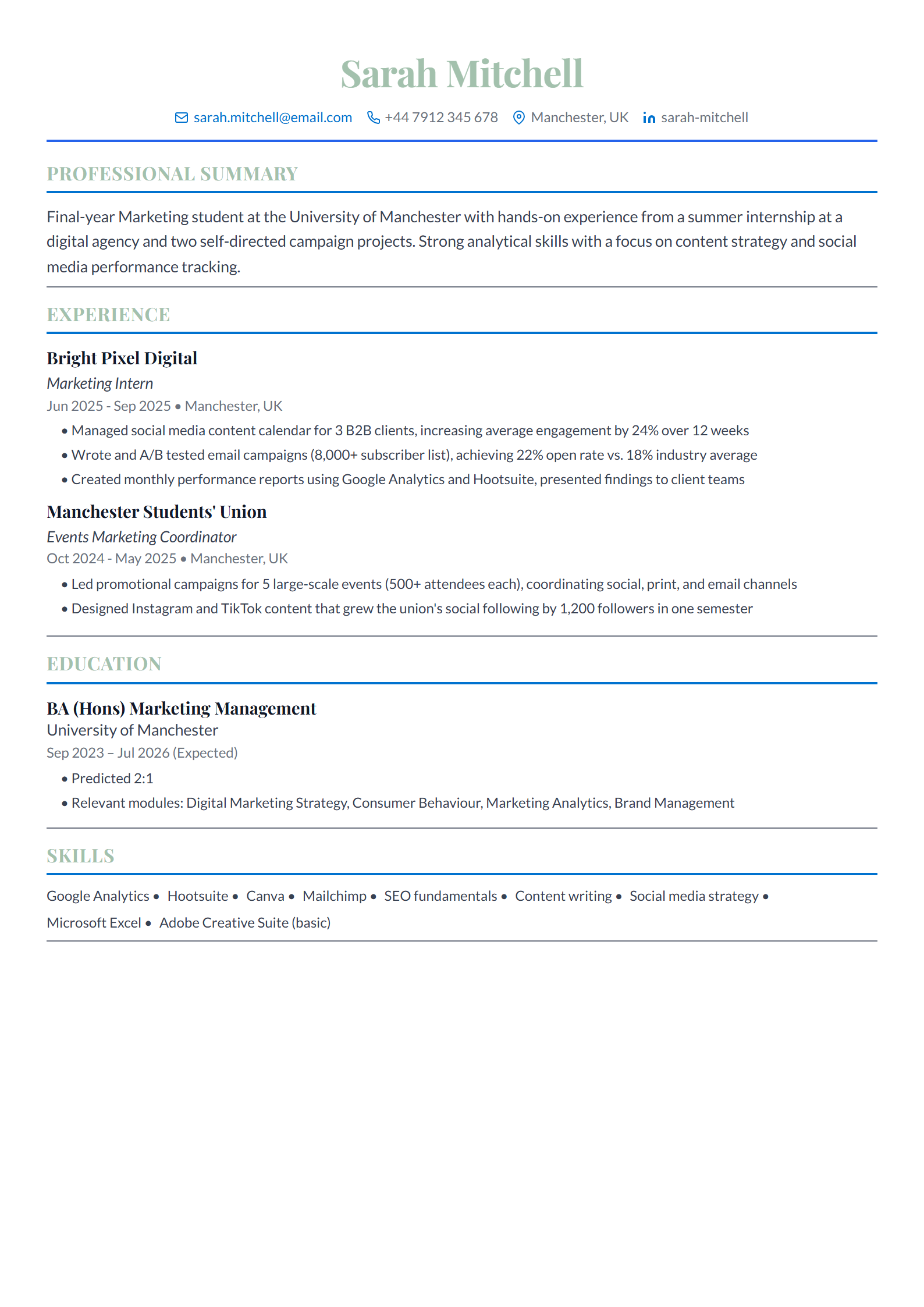
Sarah is in her final year of a BA in Marketing Management at the University of Manchester. She completed a three-month internship at a digital marketing agency called Bright Pixel Digital over the summer and holds an events role at the Students' Union. She's applying for marketing internships at mid-sized agencies and in-house teams.
What stands out
The first thing that jumps out is the personal statement. Sarah opens with a specific mention of her degree, the agency she interned at, and two concrete outcomes from that internship. Within five seconds, you know what this person does and what they've achieved. That's exactly what a hiring manager needs.
Her internship section is the strongest part of the CV. The bullet points are tight and results-driven — she mentions increasing social media engagement by 24% across three client accounts and improving email open rates by 22% through A/B testing. These aren't vague claims. They're measurable outcomes with enough specificity to be credible.
The education section is well done too. She lists three relevant modules (Digital Marketing Strategy, Consumer Behaviour, Marketing Analytics) rather than trying to cram in everything. Her predicted 2:1 is clearly stated. It's a smart move to include her dissertation topic — "The Impact of Short-Form Video on Brand Recall in Gen Z Consumers" — because it reinforces her marketing focus.
The Students' Union events role is a nice addition. She frames it in terms of coordination, budgeting, and attendance numbers rather than just listing the title. The bullet about managing a budget of over three thousand pounds and delivering an event for 400 attendees deserves special mention — that's genuine project management, and a lot of graduates would bury it or leave it out entirely.
Her skills section is clean: Google Analytics, Meta Business Suite, Mailchimp, Canva, and Excel with specific capabilities listed. She also includes a HubSpot Inbound Marketing certification, which signals genuine initiative.
Where it could improve
The most notable gap is what's missing. There's no LinkedIn URL anywhere on the CV. For a marketing candidate, that's a notable omission — recruiters in that space almost always check LinkedIn, and the absence of a link either means the profile doesn't exist (a problem) or it wasn't included (a missed opportunity).
There's also a missing languages section. Additional languages are a differentiator in the UK market, not a requirement, but even a line saying "French (conversational)" would fill a gap that the current CV leaves open. It takes up very little space and can quietly set her apart from otherwise similar candidates.
One smaller point about the personal statement: while it's strong, it doesn't mention the type of role she's looking for. Adding "seeking a marketing internship in an agency environment" would close the loop and make it even easier for a hiring manager to see the fit. If you want to dig deeper into what makes a good personal statement, our graduate CV guide covers the structure in detail.
Example 2: James Okafor — Graduate With No Formal Work Experience
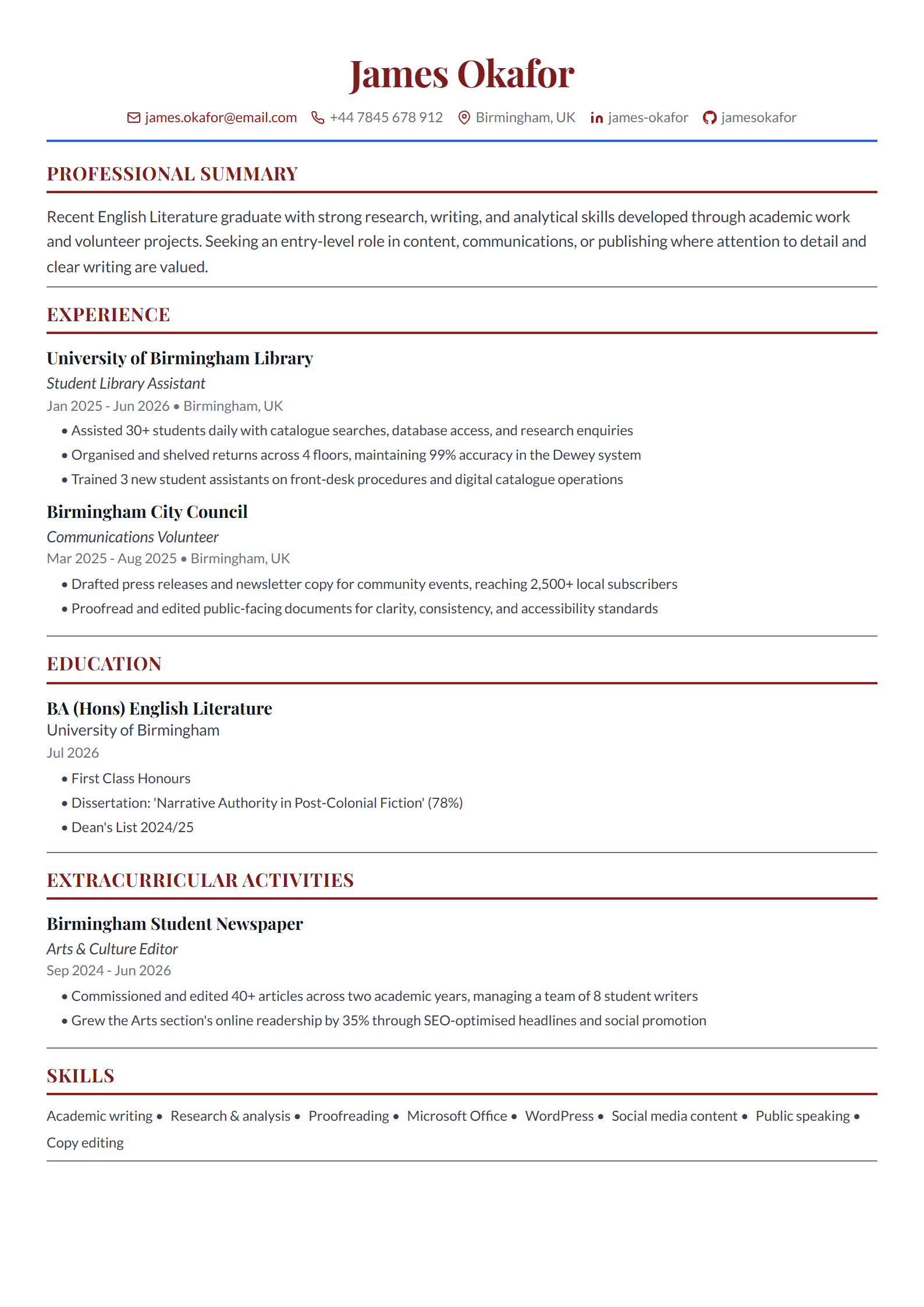
James graduated last summer with a BA in English Literature from the University of Birmingham, achieving First Class Honours. He doesn't have any paid professional experience in his target field. What he does have is a year as editor of the student newspaper, a library assistant role, and volunteer communications work for a local charity. He's applying for entry-level content, editorial, and publishing roles.
What stands out
The First Class degree is the first thing you notice — prominently placed, clearly formatted, impossible to miss. For a graduate with no industry experience, this is your headline. He's right to make it the first thing you see.
But the section that generated the most discussion was James's role as Editor-in-Chief of the Birmingham student newspaper. He ran a team of twelve writers, grew readership by 35% over two semesters, and managed an editorial calendar with weekly publication deadlines. This is functionally a content management role. He was responsible for editorial quality, team coordination, and audience growth — that's directly transferable to the jobs he's applying for. When we screened CVs for entry-level positions, this kind of extracurricular leadership carried real weight.
The volunteer communications work at a local literacy charity also landed well. James wrote press releases, managed social media accounts, and drafted a successful grant application. He framed it with the same professionalism as paid work — clear role title, organisation name, dates, and bullet points focused on outputs rather than responsibilities.
His library assistant role is less directly relevant but still useful. It shows reliability, customer service, and the ability to hold down a regular commitment alongside his studies. It doesn't need to be exciting. It needs to show that he can show up, do a job, and be trusted.
Where it could improve
The biggest issue is ordering. Leading with the newspaper editorship would make the CV significantly stronger. Right now, the CV follows a traditional structure: education first, then extracurriculars. But James's editorship is more impressive and more relevant than most of his degree details, and leading with it would immediately signal "this person has managed a publication" rather than "this person studied English."
The personal statement also needs work. James mentions a "passion for language and storytelling," which could describe anyone with an English degree. It needs something more targeted: which type of role? Which industry? Even "seeking an editorial assistant or junior content role in publishing" would sharpen the focus significantly. We've written more about this exact situation — building a CV without traditional work experience — in our no-experience CV guide.
A dedicated "Key Achievements" line under the newspaper role would also help, pulling out the 35% readership growth as a standalone highlight rather than burying it in a bullet point. When your strongest evidence is competing with four other bullets, it can get lost.
Example 3: Priya Sharma — Career-Changing Graduate (Psychology to UX Design)
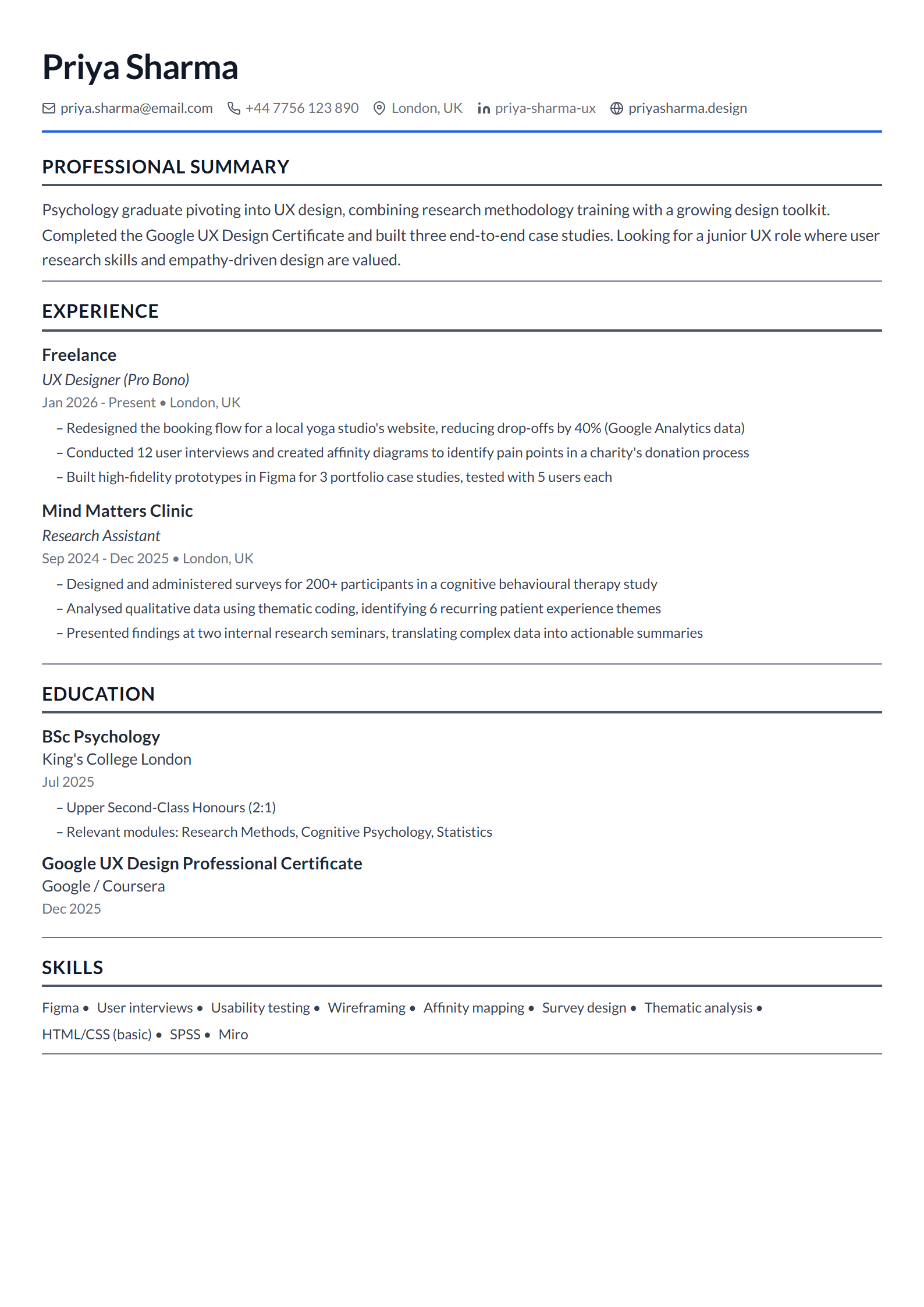
Priya graduated with a BSc in Psychology from King's College London and is now pivoting into UX design. She completed the Google UX Design Professional Certificate, has done freelance UX work for two small businesses, and has a background as a research assistant in her university's behavioural science lab. She's applying for junior UX designer and UX researcher roles.
What stands out
The standout feature of Priya's CV is the career narrative. Her personal statement directly addresses the pivot — she connects her psychology background (user behaviour, research methodology, data interpretation) to UX design, and she does it without being apologetic or defensive about changing direction. Career changers often try to hide the change. Priya leans into it. She's saying "my background makes me better at this," and she backs it up.
The freelance UX work is where the CV really earns its credibility. Priya redesigned the checkout flow for a small e-commerce business and reduced cart abandonment by 40%. She also conducted user interviews and usability testing for a local fitness app, leading to a navigation overhaul that increased session duration. These are real, quantified results that demonstrate she can do the job she's applying for, regardless of what her degree says.
The Google UX Design certificate is well-placed — listed in a dedicated "Certifications" line near the top of the CV. Smart that it isn't buried at the bottom. For a career changer, relevant certifications do a lot of heavy lifting. They say "I'm serious about this, and I've invested time in learning it properly."
Her research assistant background is also a quiet strength. She mentions conducting structured interviews, analysing qualitative data, and co-authoring a paper on decision-making under cognitive load. The connection to UX research is clear without being forced.
Including her portfolio URL is a smart move. For UX roles, a portfolio is often more important than the CV itself, so making the link easy to find is essential.
Where it could improve
The main suggestion was structural. Priya's freelance work and her research assistant role are currently under a combined "Experience" header. We'd recommend splitting the freelance UX work into a separate "Projects" section. The reasoning: when someone scans the CV quickly, a dedicated projects section immediately signals "this person has done real UX work," whereas under a generic experience header it competes for attention with the research assistant role, which — while relevant — isn't UX design.
There was also a note about the research assistant position itself. Priya lists her duties clearly but doesn't always connect them to UX explicitly. For example, "conducted structured interviews with 45 participants" is strong, but adding a parenthetical like "using methods directly applicable to user research" would make the transferable value impossible to miss. When you're pivoting, you can't assume the reader will make the connection — make it for them.
One practical suggestion: adding a "Tools" line to the skills section listing specific UX tools (Figma, Maze, Hotjar, Miro) separately from general skills. Hiring managers for UX roles often scan for these by name, and ATS systems will match on them.
Patterns Across Strong Student CVs
Looking at all three CVs together, a few things stand out.
Every strong student CV we've reviewed — not just these three, but the hundreds we've screened over the years — shares certain characteristics. The personal statement is specific and targeted, not a generic declaration of enthusiasm. The bullet points focus on outcomes, not duties. Numbers appear wherever they're available, because quantified results are more credible and more memorable than qualitative descriptions.
All three candidates treat non-traditional experience with the same seriousness as paid work. Sarah's Students' Union role, James's newspaper editorship, Priya's freelance projects — each is formatted with proper titles, dates, and achievement-focused bullet points. The formatting tells the recruiter: "I take this seriously, so you should too."
None of the three CVs try to be comprehensive. They're selective. Sarah doesn't list every module she took. James doesn't describe every library duty. Priya doesn't itemise every aspect of her psychology degree. They each chose what to include based on what's relevant to the role they're targeting, and left the rest out.
That last point is the one students resist the most. When you don't have decades of experience, there's a natural instinct to include everything. But a CV that tries to say everything ends up saying nothing. The discipline to select and tailor is what separates the CVs that get interviews from the ones that don't.
If you're building your first CV or reworking one that isn't getting results, the question isn't just what to add — it's what to cut, what to reorder, and what to reframe. We cover the skills side of that decision in detail in our student skills guide, and if you're targeting your first graduate role in the UK specifically, our graduate CV guide walks through the full format and structure.
Your Turn
These three CVs aren't perfect — and that's the point. No CV is. What makes them effective is that each one is focused, honest about what the candidate brings, and structured to make the recruiter's job easier.
Look at your CV the way a recruiter would: thirty seconds, scanning for evidence that you can do the job. If that evidence isn't immediately visible, restructure until it is.
Create your CV with Bemura — choose from templates designed for students and graduates, and use AI tailoring to match your experience to each job description you apply for.
Related Articles
Skills to Put on Your CV as a Student (With Examples)
Not sure what skills to include on your student CV? Here are the technical, soft, and transferable skills that employers actually look for — with examples of how to prove them.
Cover Letter Examples for Students & Graduates (With Feedback)
Three annotated cover letter examples for students — internship application, graduate scheme, and speculative approach. With line-by-line feedback on what works.
How to Write a CV With No Work Experience
No work experience? No problem. Learn how to build a compelling CV using your education, projects, volunteering, and transferable skills.