Cover Letter Examples for Students & Graduates (With Feedback)
Most cover letter guides give you a template and say "fill in the blanks." The result is a letter that reads like a form — technically correct but completely forgettable. We wanted to do something different.
Below are three real-format cover letters written for different student scenarios: an internship application, a graduate scheme, and a speculative cold approach. Each one is followed by the kind of feedback you'd actually get from someone who's reviewed hundreds of applications — what works, what doesn't, and what would make the letter stronger. Our team has spent years hiring for entry-level and graduate positions, and these are realistic examples with real strengths and real weaknesses, because that's how you actually learn.
Example 1: Internship Application — Sarah Mitchell
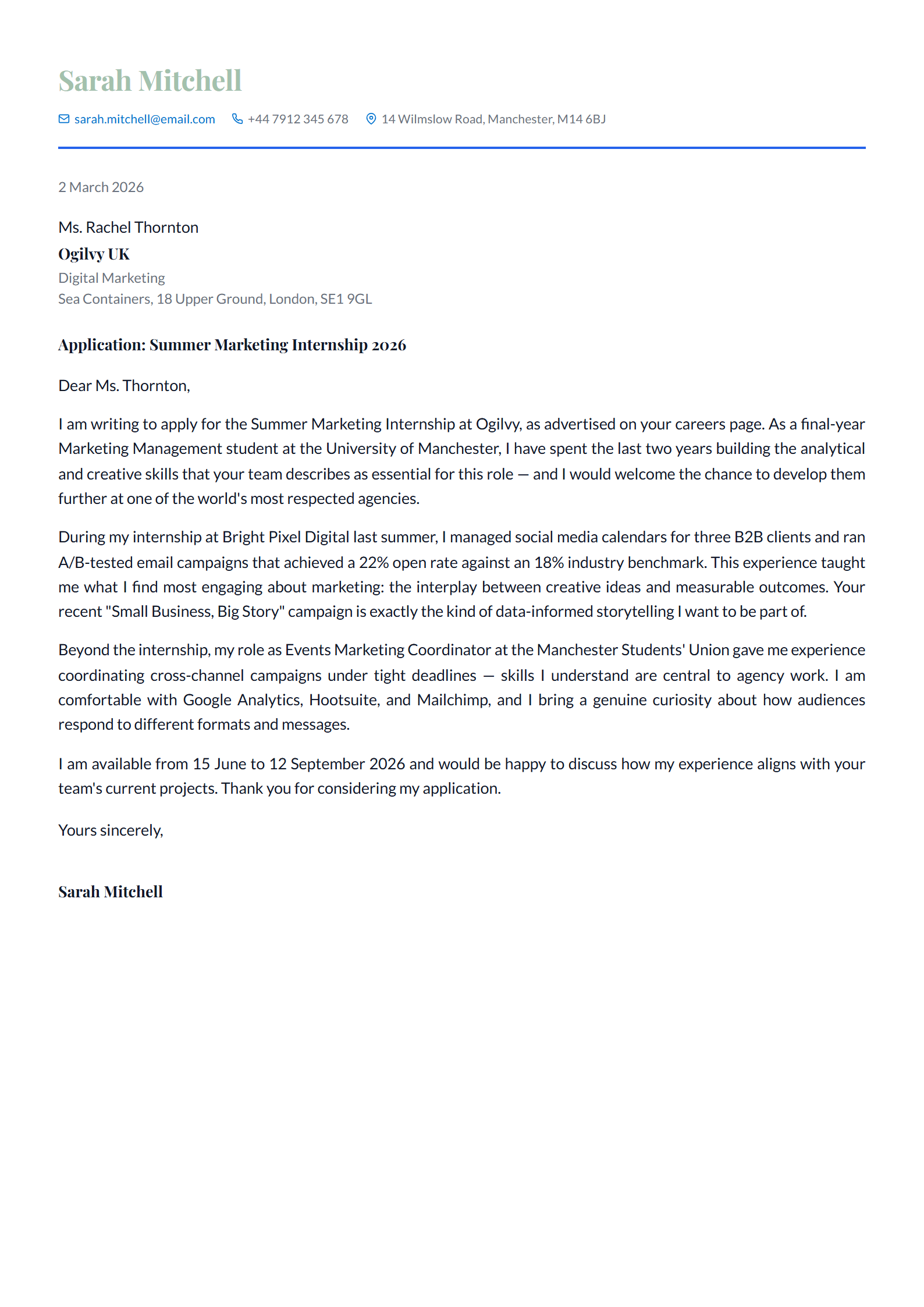
The scenario: Sarah is a final-year Marketing student applying for a Summer Marketing Internship at Ogilvy UK. She has one previous internship at a smaller digital agency (Bright Pixel Digital) and is addressing her letter to Ms. Rachel Thornton, the hiring manager listed in the job posting.
What a recruiter would say
The opening paragraph earns its keep. Instead of the usual "I am writing to apply for..." formula, Sarah leads with a specific Ogilvy campaign — their "Small Business, Big Story" series — and explains why it caught her attention. This tells the reader two things immediately: she's done her research, and she cares enough about the work to notice it. Most internship applicants don't get past the "I've always admired your company" stage. Sarah actually names the thing she admires and explains what she took from it.
Her experience paragraph is well-constructed. The Bright Pixel Digital internship doesn't just appear as a line on a CV — she pulls out a specific metric (a 22% email open rate she achieved on a client campaign) and connects it to the kind of work she'd do at Ogilvy. This is the right approach. Recruiters reviewing internship applications know you won't have ten years of results. But one concrete number beats five paragraphs of vague enthusiasm.
The clear availability dates in the closing are a small detail that matters more than students think. Graduate and internship recruiters often manage dozens of applications with overlapping timelines. Telling them exactly when you're available saves a back-and-forth email and makes you easier to say yes to.
Where the letter falls short is in specificity about contribution. Sarah does a strong job explaining why she admires Ogilvy, but the letter would be sharper if she spent a sentence or two on what she'd specifically bring to the team. What would she do differently because of her Bright Pixel experience? What gap could she help fill? It's a subtle shift — from "I want to learn from you" to "here's what I'd bring while I learn" — but it makes a noticeable difference at the shortlisting stage.
The closing paragraph is functional and professional. It does the job. But it's also the most templated-sounding part of the letter. A sentence that reflects genuine enthusiasm — something beyond "I would welcome the opportunity to discuss" — would leave a stronger final impression.
Example 2: Graduate Scheme — James Okafor
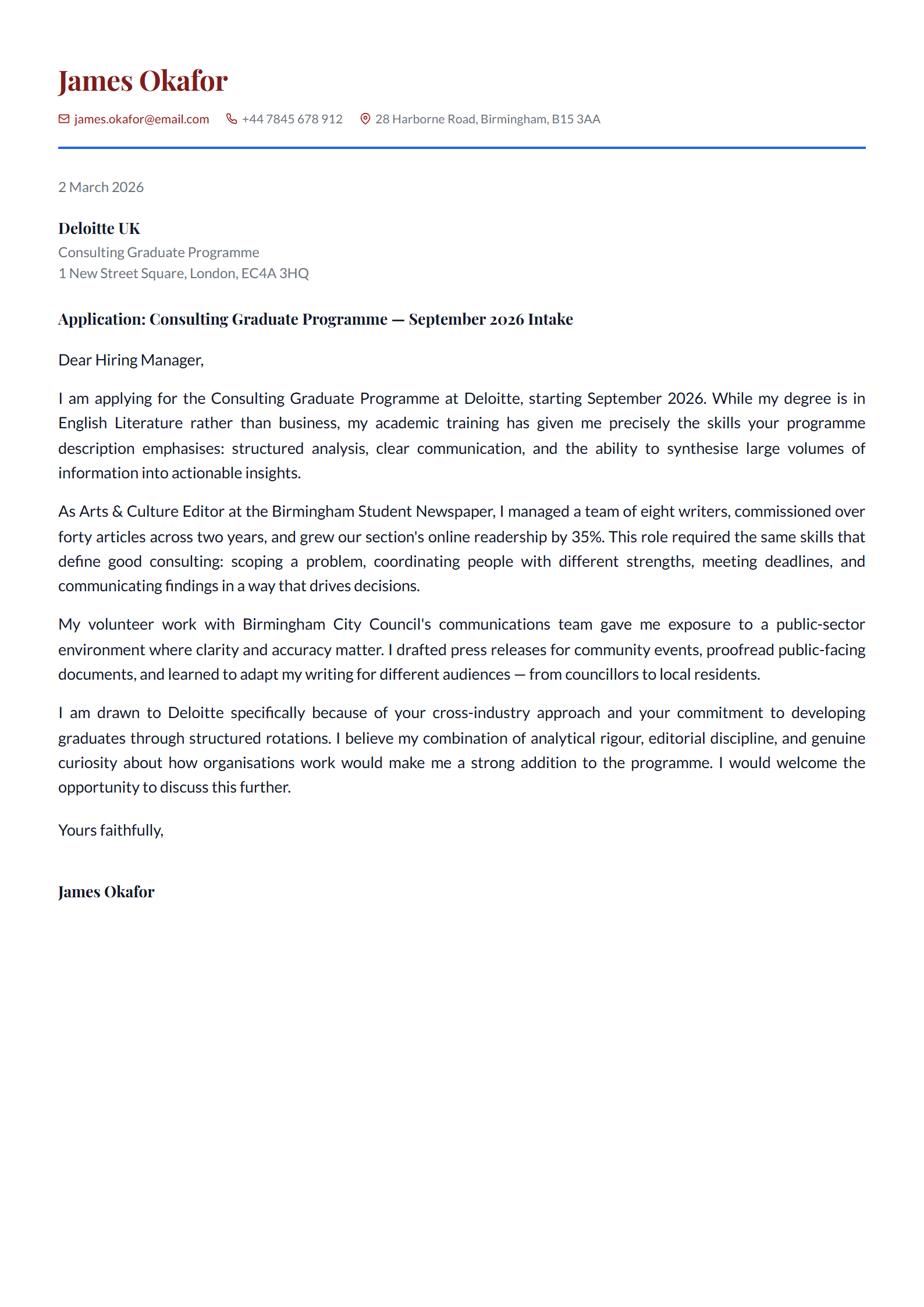
The scenario: James studied English Literature and is applying for Deloitte's Consulting Graduate Programme. He knows his degree isn't the typical route into consulting, and rather than hiding from that fact, he addresses it directly. The letter is addressed to "Dear Hiring Manager" since Deloitte's application portal doesn't name a specific person.
What a recruiter would say
The single strongest move in this letter is the reframing. James doesn't apologise for his English Literature degree or try to pretend it's something it isn't. Instead, he draws a direct line between the skills he developed and the skills consulting requires. Leading the university newspaper team becomes "scoping ambiguous problems and coordinating people with different expertise toward a shared deadline." That's not spin — it's an accurate translation of what the work actually involved, expressed in terms a consulting firm understands.
This matters because graduate scheme recruiters at firms like Deloitte explicitly say they hire from all degree backgrounds. But saying that and doing it are different things. The candidates who succeed from non-traditional degrees are the ones who do the translation work themselves, rather than hoping the recruiter will connect the dots. James does this well.
The paragraph on his public sector volunteering is a smart inclusion. It bridges two worlds — showing he understands organisations with social missions but is now interested in applying that thinking commercially. Consulting firms care about this blend. Client-facing consulting isn't just analytical skill; it's the ability to work with people in complex organisations, and James's experience signals that.
His tone is confident without tipping into arrogance, which is harder than it sounds. A lot of graduate cover letters either undersell ("I believe I could potentially contribute") or oversell ("I am confident I will be an outstanding asset"). James lands in the middle, and it reads as genuine.
One gap: commercial awareness. Consulting recruiters look for evidence that candidates follow business news, understand market dynamics, or have an opinion about an industry. James could strengthen this letter by mentioning a specific sector he's interested in — technology, public sector transformation, financial services — and briefly saying why. It would signal that he's thought beyond "I want to do consulting" to "I want to consult on this."
A small note on convention: James uses "Yours faithfully" to close, which is the correct British convention when addressing "Dear Hiring Manager" (as opposed to "Yours sincerely" for a named recipient). It's a minor detail, but consulting firms notice these things. Good instinct.
Example 3: Speculative Application — Priya Sharma
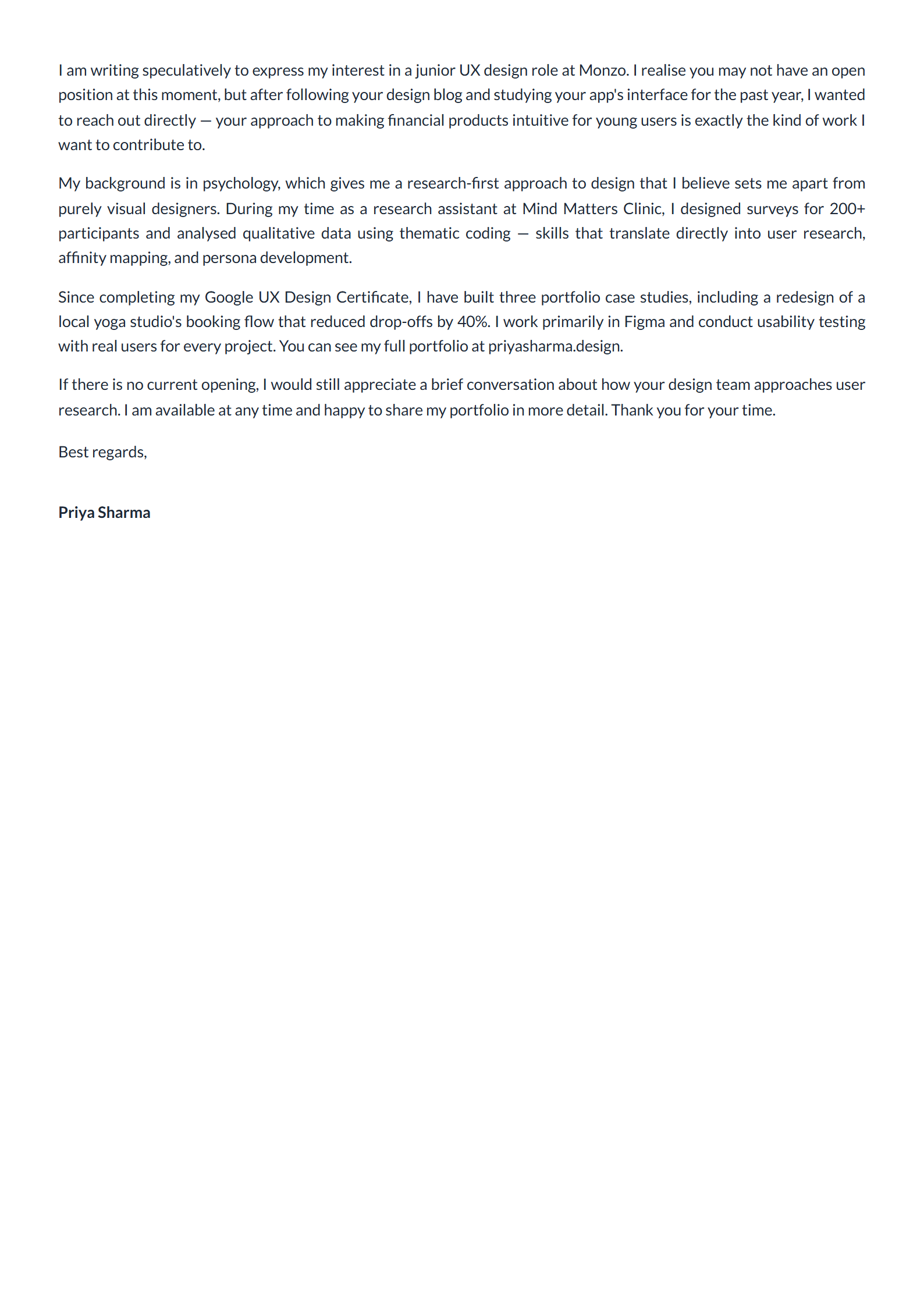
The scenario: Priya is a Psychology graduate who's pivoted into UX design through self-study and project work. She's writing a speculative letter to Monzo's product design team — there's no open position. She's reaching out because she genuinely wants to work there and is creating her own opportunity.
What a recruiter would say
Speculative letters have a high bar. There's no job listing pulling you forward, no role description to anchor your pitch. Everything depends on the letter itself making someone think "we should talk to this person." Priya's letter clears that bar, and the reason is honesty.
She opens by acknowledging there's no open role. This sounds risky, but it's actually disarming. It says: "I'm not mass-applying to everything. I chose you specifically, and I know the situation." That reframing turns what could feel presumptuous into something refreshing. Hiring managers at companies like Monzo — who receive thousands of unsolicited applications — notice when someone cuts through the noise with directness.
Her product knowledge is concrete. She references Monzo's design blog and their approach to user research, which tells the reader she's been paying attention over time, not just glancing at the About page before hitting send. For speculative applications, demonstrated knowledge of the company's work is the single biggest differentiator. It's the difference between "I'd love to work at Monzo" and "I've followed how your team approaches X, and here's why that resonates with my own work."
The portfolio evidence is strong. Priya cites a specific project where she reduced a 40% drop-off rate in a sign-up flow — that's a real UX problem with a measurable outcome. For someone without a traditional design background, this kind of evidence does more work than any degree could. It proves she can do the job, which is ultimately what matters.
Her closing is particularly well-judged: "even just a conversation" is a low-pressure ask that makes it easy for someone to say yes. She's not demanding a job. She's asking for a door to open slightly. This is exactly the right tone for a speculative approach.
Where could it improve? The company knowledge, while good, stays at the level of "I follow your blog." Naming a specific Monzo design decision — a particular feature they shipped, a design tradeoff they wrote about — would elevate this from "she knows about us" to "she thinks like us." It's a small change that would make the letter substantially more memorable.
The portfolio link is mentioned in the letter, which is essential. But it could stand out more. In a block of text, a URL can get lost. If the format allows it, giving the link its own line or making it visually distinct would help ensure it doesn't get missed — because the portfolio is the most important thing in this entire application.
Five Things Every Strong Student Cover Letter Has
Looking across all three examples, patterns emerge. These aren't arbitrary rules — they're the things that consistently separate letters that get read from letters that get skimmed.
Specificity about the company, not just the role. Sarah names a campaign. James connects his volunteering to commercial consulting. Priya references a design blog she's followed for months. None of them could send the same letter to a different company without rewriting significant portions. That's the test. If your letter works equally well for five different companies, it isn't specific enough.
At least one concrete metric or outcome. A 22% open rate. A 40% drop-off reduction. You don't need a portfolio of numbers, but one piece of quantified evidence changes the entire weight of a letter. It moves you from "I'm enthusiastic" to "I've done things that had measurable results."
An honest acknowledgment of where they are. Sarah is upfront about being a student. James addresses his non-traditional degree head-on. Priya admits there's no open role. None of them pretend to be something they're not, and paradoxically, that honesty makes them all more convincing. Recruiters can spot performance. Authenticity is harder to fake.
A clear, low-friction close. Each letter ends with a specific next step that's easy for the recruiter to act on. Availability dates, a request for a conversation, an invitation to discuss further. The close isn't where you make your pitch — it's where you make it easy for someone to respond. Remove every barrier you can.
Appropriate tone matching. Sarah's letter is professional but warm — right for a creative agency. James's is more formal — right for consulting. Priya's is direct and personal — right for a speculative approach to a tech company. They read the room. The best cover letter in the world fails if it's written in the wrong register.
Making This Easier
Writing a cover letter from scratch for every application is time-consuming. Writing one that's genuinely tailored — with specific company research, relevant metrics, and the right tone — is even harder. That's the reality, and there's no shortcut around the research part.
But the structural work — formatting, layout, making sure every section is in the right place and nothing's missing — doesn't have to eat your time. If you're also working on the CV side of your applications, our guide to writing a CV with no experience and our graduate CV guide for the UK market cover the other half of the equation.
And once your CV and cover letter are both strong, the next challenge is making sure they actually get through automated screening systems. Our ATS optimization guide walks through exactly how that works and what to do about it.
If you want a starting point that handles the structure and formatting so you can focus on the content that matters — the research, the specifics, the voice — Bemura's cover letter builder gives you professionally designed templates and AI-assisted drafting that adapts to the role you're targeting. It won't write your company research for you (nothing should), but it will make sure the result looks polished and reads well.
Related Articles
Student & Graduate CV Examples — With Honest Feedback
Three real-world CV examples for students and graduates — each reviewed with honest feedback on what works and what to improve.
UK CV and Cover Letter Conventions: The Rules Nobody Teaches You
Everything international students and graduates need to know about UK CV conventions — from what to leave out to what recruiters scan for first. A practical guide based on the Equality Act, recruiter surveys, and real hiring patterns.
How Hiring Differs by Industry in the UK: What Graduates Need to Know
Finance, law, tech, consulting, creative, and public sector hiring all follow different rules. Here's what actually changes by industry — so you don't apply to a law firm like it's a startup.